



If your partner is having an affair, how can you protect your dignity and rights by exercising your "spousal rights" in the face of infidelity? After the decriminalization of adultery, how should you safeguard your interests and take action?
This article has compiled answers to 6 common questions about the infringement of spousal rights, along with a clear guide to the legal process — from evidence collection and presentation, to claiming compensation, filing appeals, and reaching settlements. Everything you need to know about defending your rights is covered here!
Table of Contents
What is the violation of spousal rights? Understand the 6 most common questions and how to exercise your spousal rights.

-
What is the definition of the violation of spousal rights?
The violation of spousal rights is a tort under civil law, which infringes on someone’s "spousal rights." The civil law protects property rights, personality rights, and identity rights, etc., and spousal rights are a form of identity rights aimed at ensuring a happy and secure family life. If one party violates the duty of loyalty to the marriage, it constitutes a violation of spousal rights.
Violation of spousal rights does not only occur in the case of adultery or sexual behavior with another person. Even sending ambiguous messages, taking intimate photos, or other actions that do not reach the threshold of adultery fall under the category of violating spousal rights. Civil lawsuits can be filed under Articles 184, 185, and 195 of the Civil Code to seek damages.
-
Can I file a lawsuit for violation of spousal rights after divorce? How long is the statute of limitations for violation of spousal rights?
It is possible to file a lawsuit for violation of spousal rights after divorce. The statute of limitations for violation of spousal rights is 10 years. However, if you are aware of the violation, you must file a lawsuit within 2 years. If you do not, the lawsuit will be invalid. If you discover the third party after the divorce, you can file a lawsuit within 10 years from the time the adultery occurred. In addition to the third party, you can also seek compensation from your spouse.
-
What evidence is needed for violation of spousal rights?
Ambiguous messages, chat records, credit card records, photos, and recordings can all be used as evidence of a violation of spousal rights. However, whether they will be accepted depends on the judge’s discretion. For example, phrases like “I love you,” or calling someone “husband” or “wife” might be accepted, but simply frequent chatting may be considered as normal friendship. For photos, if they were taken in public and there are no obvious intimate gestures, they may not be accepted. Credit card records showing clear details of motel stays need additional supporting evidence. Additionally, if the spouse admits the violation and signs related documents or if there are related recordings, these can also serve as evidence. The amount of compensation for violating spousal rights is determined by factors such as the defendant's income and education background. It is easier to obtain compensation with direct, complete, and multiple pieces of evidence. Lastly, when collecting evidence, you should also pay attention to the principle of proportionality to avoid being countered.
-
In what cases will there be no compensation for violation of spousal rights?
If you can prove that you did not know the other party was married, you might not need to pay compensation. Evidence like chat recordings or screenshots of messaging app conversations can be presented to show that you were unaware. However, even if you were unaware of the marriage, the judge may still require compensation for negligent infringement, so caution is necessary.
-
Can you file a lawsuit for violation of spousal rights without attending court? What about reconciliation?
Violation of spousal rights is a civil lawsuit, and both the plaintiff and defendant can be represented by attorneys, unless the judge believes it is necessary to clarify the facts. If you are dissatisfied with the result, you can appeal, but if the amount is less than 1.5 million NTD after the second trial, you cannot appeal to the third trial.
During the lawsuit, you can suspend the litigation. After suspension, you have one more opportunity to file the lawsuit again. If there is no action within 4 months, the case is considered withdrawn. After the second lawsuit, if you wish to suspend again, the court will not accept it. Also, reconciliation can take place in court, and the effect of reconciliation is the same as a judge's ruling, and no objections can be raised.
-
Does the other party’s infidelity still apply to criminal law?
When people think of a spouse’s infidelity or adultery, they usually think of criminal law Article 231, also known as the "adultery law." However, after the interpretation of the Constitutional Court (791) on May 29, 2020, the adultery law was declared unconstitutional, officially ending the 85-year-old criminal punishment for adultery. Now, you cannot file a lawsuit for violation of spousal rights based on criminal punishment. In the previous adultery law, Article 239 of the litigation law allowed a spouse to withdraw charges against their spouse, resulting in third parties often being forced to bear all criminal responsibility and compensation. Since adultery is not committed by one person alone, it was considered inconsistent with the constitutional principle of equality, and thus declared unconstitutional.
The lawsuit process for violation of spousal rights | 5-step complete litigation process
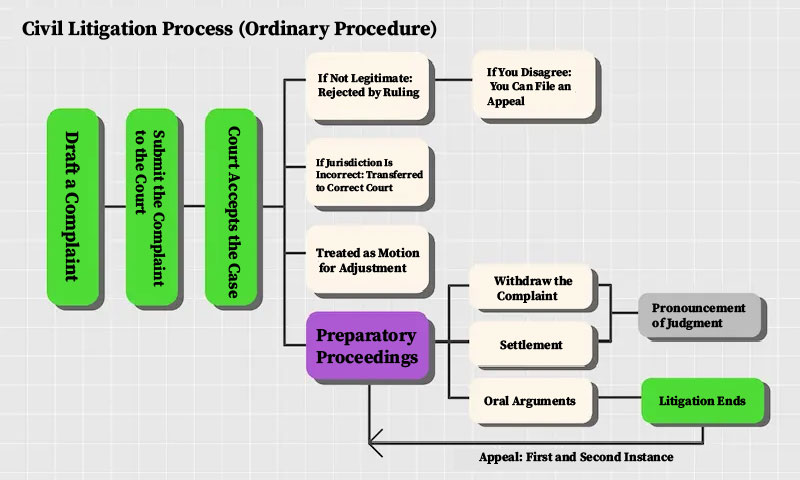
The lawsuit for violation of spousal rights is a civil lawsuit, and the filing process is the same as for other civil lawsuits:
-
First, the plaintiff must file a lawsuit and prepare a written complaint. Once the complaint is submitted, it will be reviewed and accepted by the court.
-
After the court accepts the case, the next step is to "present evidence" during the pre-trial preparation phase. Before moving forward, if there is any possibility of mediation, the court will usually encourage both parties to settle the matter during this stage.
-
If the case cannot be resolved through mediation and must proceed to trial, the next step will be the formal investigation of evidence.
-
Following the evidence investigation, several possible outcomes may occur:
- The evidence is deemed inadmissible, and the appeal is dismissed.
- The court offers both the plaintiff and the defendant a chance to reach a settlement.
- If no settlement is reached, the case moves to oral arguments, where both sides present their claims and disputes, and the court will ultimately render a judgment.
-
If either party wishes to appeal the judgment, the case will proceed to the second instance (appellate court), repeating the preparation procedures until the final ruling is reached.
